Oh, You Thought THAT Miniature Would Be Your Best Seller?
Confronting Your Own Bias
When Expectations Feel Obvious
A few months after the business launched, we did our first real product line expansion.
We added Ice Elementals.
I didn’t expect much from them sales-wise. I loved the paint scheme I had landed on, and the dry brushing was driving my wife absolutely nuts—which, if I’m being honest, was a bonus. But in my head, this was never going to be a top performer.
I was convinced the Fire Elementals would be our best line.
After all, fire fits everywhere. D&D, Pathfinder, homebrew settings—you name it. Ice elementals? They show up far less often. On paper, it felt obvious.
But Schlossbauer had made such a great sculpt, and I liked the finished result so much, that we launched them anyway.
The Ice Elementals Surprise
Three months after the business started, we put them up.
Within the first month and a half, we had already sold more Ice Elementals than Fire Elementals.
That didn’t make sense.
Yes, they looked great. The small ones were especially hard not to like. But there are objectively fewer ice elementals in published games. So why were they moving so well?
That’s when I stopped assuming—and started thinking.
First, there was the obvious factor: while you can find plenty of unpainted ice elementals, there are very few painted options available. Supply and demand matters, even in a niche hobby.
Second, and more interesting, was the realization that not everyone buying miniatures is buying them strictly for the table. Some people were almost certainly buying them as desk pieces or shelf displays. They read clearly. They photographed well. They stood on their own.
That was the first time I realized my assumptions were too narrow.
The Huge Snake Lesson
The second surprise came with our Huge Snakes.
In my mind, these were filler catalog items. They looked great, the price point was strong for a 75mm base, but I expected the occasional sale—nothing more. A nice option to have, not a mover.
Instead, in the first couple of months, we sold around six.
That alone was more than expected, but what really caught my attention was how they were selling. We were moving far more unpainted Huge Snakes than painted ones.
On the surface, that felt strange. It’s a massive snake. It’s not something every table needs.
But again, the market was answering a question I hadn’t thought to ask.
There weren’t many comparable options available. And for people who enjoy painting or converting, it turned out to be a perfect canvas.
When the Pattern Became Clear
The most telling example, though, has been the Metal Elementals.
They launched alongside the Fire Elementals. Same timing. Same effort.
Yet outside of the Ice Elementals, they’ve consistently been one of our strongest performers—both painted and unpainted. Stronger, in fact, than the Fire Elementals I had been so confident about early on.
That was the pattern finally clicking into place.
Letting Go of Assumptions
What this experience forced me to confront is simple:
What your customer wants is not always what you expect.
And that realization is freeing.
Once you stop trying to predict winners based purely on your own preferences, you give yourself room to create more honestly. You can make things because they’re interesting, because they’re well executed, or because they push your skills forward—not just because they fit neatly onto a game board.
Creating Beyond the Game Board
That mindset is how we ended up creating our Arcane Elementals.
They don’t exist in D&D or Pathfinder. There’s no official stat block waiting for them.
We originally released them as a small special run—just five pieces.
All five sold.
Because of that response, they’re now being brought back as a staple offering, positioned in our newly created premium medium tier.
Not because they’re "necessary," but because they’re well made—and because experience has taught me that my initial assumptions are often the least reliable part of the process.
Sometimes the best thing you can do is make the thing you believe in, put it out there, and let the market answer honestly.
More often than not, it will surprise you.
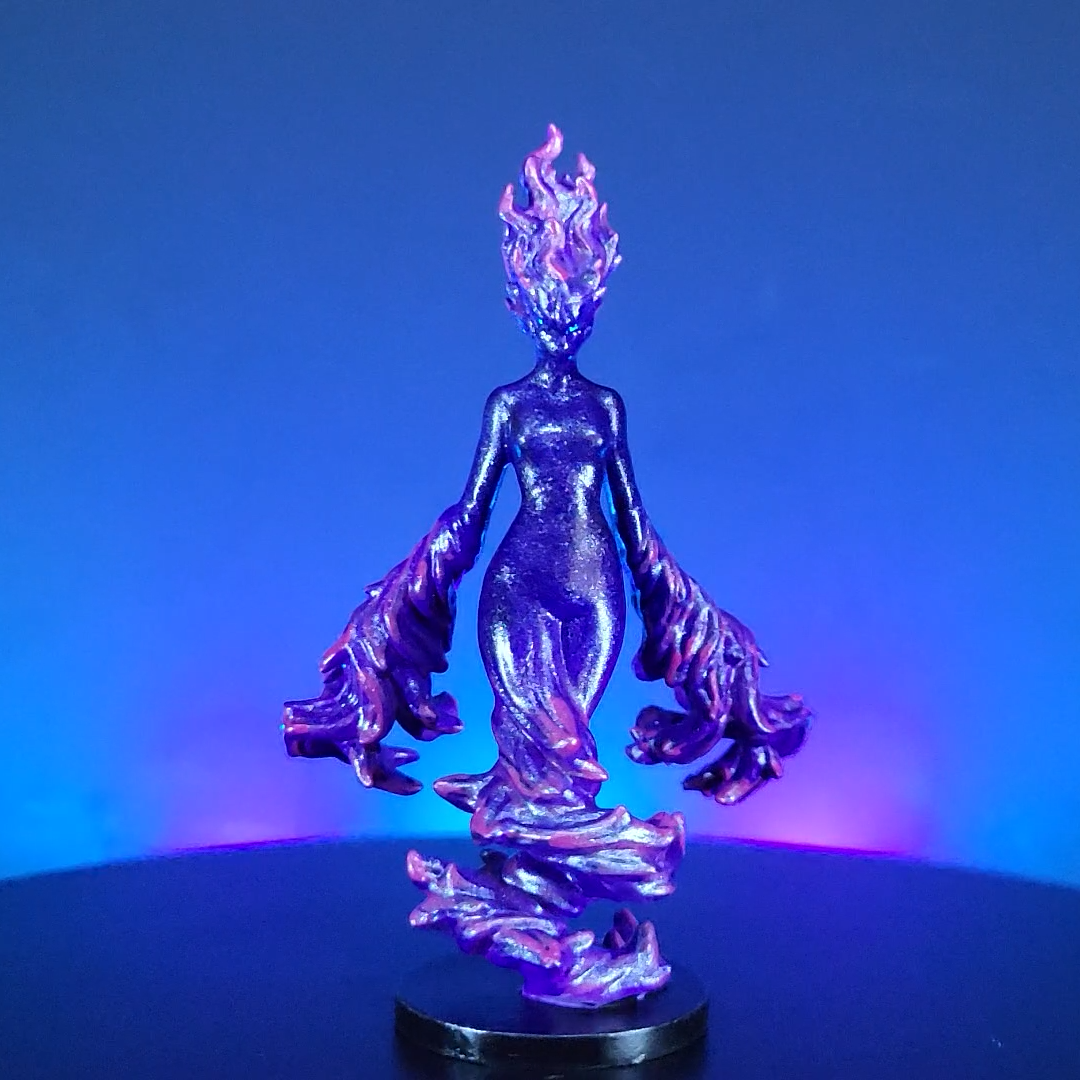
Arcane Elemental
